 Tyler Leak Repair Experts
Ultrasonic Leak Detection in Tyler, TX
Ultrasonic leak detection listens above the range of human hearing. The turbulence of water or gas forcing through a pressurized opening throws off high-frequency sound, and an ultrasonic sensor translates that down into something we can hear in a headset.
Prefer to talk first? Call (903) 651-5125 and describe what you are seeing.
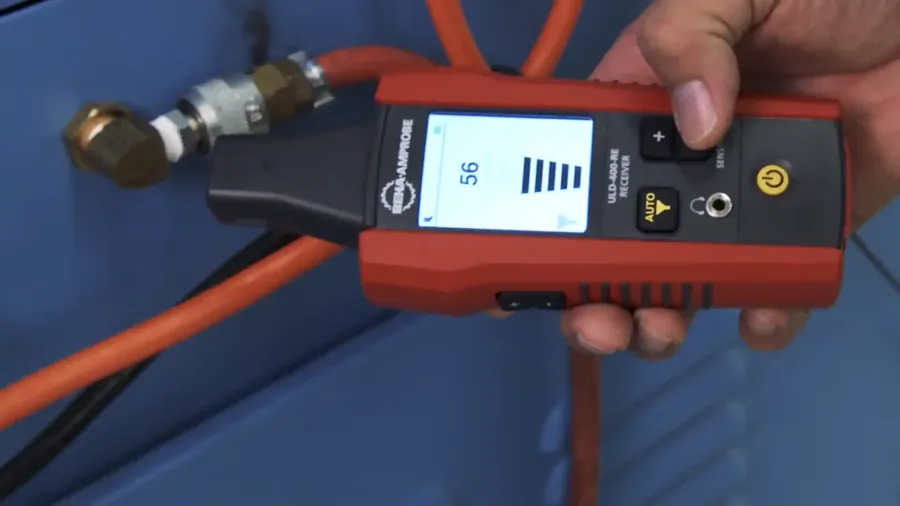
Sound you cannot hear on your own
When fluid escapes under pressure, the turbulence at the breach produces ultrasound, sound at frequencies far above what the human ear catches. That ultrasound is highly directional and does not travel far, which is exactly what makes it useful: it points tightly back toward its source rather than echoing around a room.
An ultrasonic detector picks up those high frequencies and shifts them down into the audible range through a headset, while a meter shows the intensity. As we sweep toward the leak, the sound sharpens and the reading climbs, leading us in.
Where ultrasonic beats plain listening
Because ultrasound is directional and the background noise of a house lives mostly at lower frequencies, ultrasonic detection cuts through clutter that masks a leak from a standard microphone. On a noisy site, or for a small high-pressure leak that barely whispers in the audible range, the ultrasonic sensor often hears what plain acoustic cannot.
It is also useful above the floor: a pressurized fitting weeping inside a wall or at a manifold gives off ultrasound that the sensor traces to the exact fitting, even when several run close together.
The limits of the method
Ultrasound's short range is a strength for precision and a weakness for reach. It does not travel through soil or thick slab the way lower-frequency leak sound does, so for a deeply buried line we lean on standard ground microphones and correlation instead, and bring ultrasonic in for the close-up confirmation.
And like all sound-based methods, it needs pressure and turbulence. A still, unpressurized drain produces no ultrasound to find, so those leaks go to a camera or tracer gas.
At the wall, the manifold, and the valve
Ultrasonic detection is at its best above the floor, at the fittings. A pressurized connection weeping inside a wall, a manifold of irrigation valves where one will not seat, or a cluster of supply lines behind a vanity all give off ultrasound that the sensor traces to the exact part, even when several fittings sit inches apart.
That precision is hard to match with lower-frequency listening, which hears the general area but not always the individual fitting. When the question is which of three connections is the leaker, the directional ultrasonic sensor usually answers it cleanly.
Pinpointing, then repairing
Ultrasonic detection is often the close-range finisher. Acoustic or correlation gets us to the area, and the ultrasonic sensor narrows it to the exact fitting or spot, so the repair opens the smallest possible access. We recheck with the sensor after the repair to confirm the ultrasound is gone.
For pressurized leaks in busy or complex spaces, it is one of the most precise tools we carry, and it pairs naturally with the other methods rather than replacing them.
Small pressurized leak hiding in noise?
Talk it through with a licensed Tyler leak specialist, any hour.
☎ (903) 651-5125Questions Tyler homeowners ask
What makes ultrasonic different from regular acoustic detection?
It listens above human hearing. The high-frequency ultrasound a pressurized leak makes is directional and cuts through the lower-frequency noise of a house, so it often finds small leaks that a standard microphone misses.
Why can't I just use my ears?
The sound is above the range you can hear. The detector shifts that ultrasound down into a headset so we can follow it, and shows the intensity on a meter as we close in.
Is ultrasonic good for buried pipes?
For deep lines, less so, because ultrasound does not travel far through soil or slab. We use ground microphones and correlation for depth and bring ultrasonic in for close-range pinpointing.
Will it find a drain leak?
No. With no pressure and no turbulence, a drain makes no ultrasound. Those leaks go to a camera or tracer gas instead.
When would you use it on my home?
For a small high-pressure leak, a weeping fitting inside a wall, or a noisy site where standard listening struggles. Call (903) 651-5125 and we will bring the right tool for your leak.
Can you tell which of several fittings is leaking?
Yes, that is a strength of the method. Ultrasound is directional, so the sensor traces the sound to the exact fitting even when several sit close together behind a wall or at a manifold.
Keep going ☎ (903) 651-5125
Find it first. Then fix it.
One call gets a licensed Tyler leak specialist on the line, 24 hours a day.
☎ (903) 651-5125