 Tyler Leak Repair Experts
Infrared Leak Detection in Tyler, TX
Infrared is the science underneath thermal imaging, and we use it in more ways than a single camera. Every surface radiates infrared energy in proportion to its temperature, and reading that energy, by camera, by spot sensor, or as a moisture map, tells us where water has traveled.
Prefer to talk first? Call (903) 651-5125 and describe what you are seeing.
The principle, not just the picture
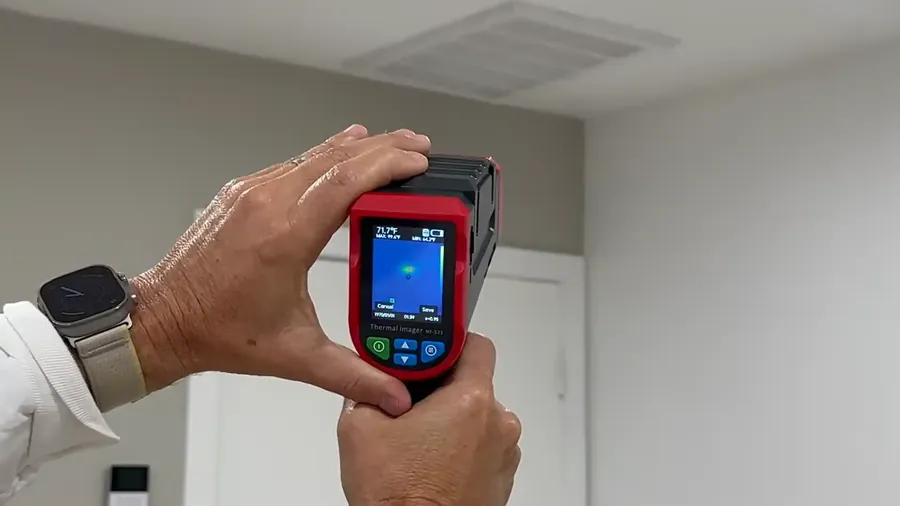
Infrared energy is heat we cannot see, given off by everything around us at a rate set by its temperature. A wet spot, cooler from evaporation or warmer from a hot line, radiates differently than the dry surface around it. Infrared detection is the practice of reading that radiated energy to find the difference moisture creates.
A thermal camera is one infrared instrument, the one that builds a full image. But infrared also gives us spot radiometers that read a precise temperature at a single point, which we use to check a specific fitting, a length of baseboard, or a suspected spot the camera flagged.
Mapping how far the water went
One of the most useful things infrared does is define the edges of a problem. A moisture map built from infrared readings shows where the wet area ends, which matters as much as where it starts. Knowing the full extent tells us whether a leak touched one stud bay or spread across several, and how much of a ceiling or wall the moisture really reached.
That boundary reading guides both the search and the eventual cleanup. We can tell you, before opening anything, the size of the wet zone behind a Tyler wall, which is far better than discovering it mid-repair.
Where infrared helps and where it does not
Infrared is a confirming and mapping tool more than a pinpointing one. It tells us a surface is wet and how far the moisture extends, and it traces the temperature signature of a line, but it reads only what the surface temperature reveals. A leak deep below with no thermal trace at the surface stays invisible to it.
It also depends on a temperature contrast, so the same limit applies as any heat-based method: a leak at exactly room temperature is hard to see. We use infrared to narrow and confirm, then acoustic or tracer gas to fix the precise point.
Reading a spot before the repair
When the camera or the symptoms point to an area, an infrared spot reading checks it directly: is this stud bay wetter than its neighbor, is this section of slab warmer along the hot line, does this baseboard read cool from moisture behind it. Those targeted readings firm up the diagnosis before we open the smallest possible access.
After the repair, infrared confirms the area is returning to a normal, even temperature, a sign the moisture is clearing rather than lingering behind the surface.
A confirming layer over the other tools
Infrared rarely works alone, and that is by design. It is the layer that confirms what acoustic listening suggests, maps what a thermal scan begins, and verifies a repair afterward. Combined with the listening and gas methods, it rounds out a picture no single tool gives. Call (903) 651-5125 and we will use the mix your leak calls for.
Need to map how far a leak spread?
Talk it through with a licensed Tyler leak specialist, any hour.
☎ (903) 651-5125Questions Tyler homeowners ask
How is infrared different from thermal imaging?
Thermal imaging is one infrared tool, the camera that builds a full picture. Infrared is the broader principle, and we also use spot sensors and moisture maps that read radiated heat to confirm and bound a wet area.
What is infrared best at?
Mapping how far moisture has spread and confirming a suspected spot. It defines the edges of a wet zone, which matters for both the diagnosis and the cleanup.
Can infrared find a deep leak?
Only if it leaves a temperature trace at the surface. A deep leak with no thermal signature stays invisible to it, so we pair infrared with acoustic or tracer gas for those.
Does it need a temperature difference?
Yes. Infrared reads heat, so a wet spot has to be cooler or warmer than its surroundings to show. A leak at room temperature can be faint, which is why we combine methods.
Will you use it to check the repair worked?
Yes. An infrared pass afterward shows the area returning to an even temperature, confirming the moisture is clearing. Call (903) 651-5125 and we will read it before and after.
Keep going ☎ (903) 651-5125
Find it first. Then fix it.
One call gets a licensed Tyler leak specialist on the line, 24 hours a day.
☎ (903) 651-5125